• Home
  • Books
    • The Story of Now
    • BeYOUtiful: Radiate Confidence, Celebrate Difference & Express Yourself
    • The Extraordinary Life of Serena Williams
    • Generation M: Young Muslims Changing the World
    • Love in a Headscarf: Muslim Woman Seeks the One
  • Media
  • Blog
  • Contact
Shelina Janmohamed

News and updates

Reflecting on my dad

1/1/2024

 
Picture

I am heartbroken to share the news that my beloved father passed away two weeks ago.
He was a man who embodied history but, as in the case of so many men like him, it is unlikely that you will find his name in history books.
My father was born in a small town called Mingoyo in the late 1930s, in today’s Tanzania, then Tanganyika. His father, from Kutch, India, had been working in trade in the British Empire port of Aden, and eventually came to Tanganyika where he married my grandmother.
Mingoyo was a small but increasingly bustling town as the British grew their presence and commerce after gaining control of the region from the Germans. It became a stopping point between the bigger coastal town of Lindi and the East African interior.
My grandfather was a businessman, bought land, mills, and at one point even travelled to Nairobi after the end of the second world war to buy trucks that the British government were disposing of.
As a young boy of 14 or so, my Dad moved to Lindi to pursue his secondary education. There he stayed in a hostel set up for Muslim students, attached to the mosque. His friends from those days nearly eight decades on still have a closeness and sweetness to their friendships.
In order to establish himself financially, he started working for the local oil company, which later turned into Mobil and then Esso. As part of his work, he travelled across East Africa and at one point found himself in Tanga, my Mum’s home town. After being introduced by mutual friends, he unsurprisingly took a shine to this radiant, soft-hearted, talented, beautiful woman and soon they married and moved to Dar es Salam, the capital.
I suspect he was a cool cat in his youth, because during this period it was the height of Bollywood, and my Dad was often compared to the actor and star Raaj Kumar.
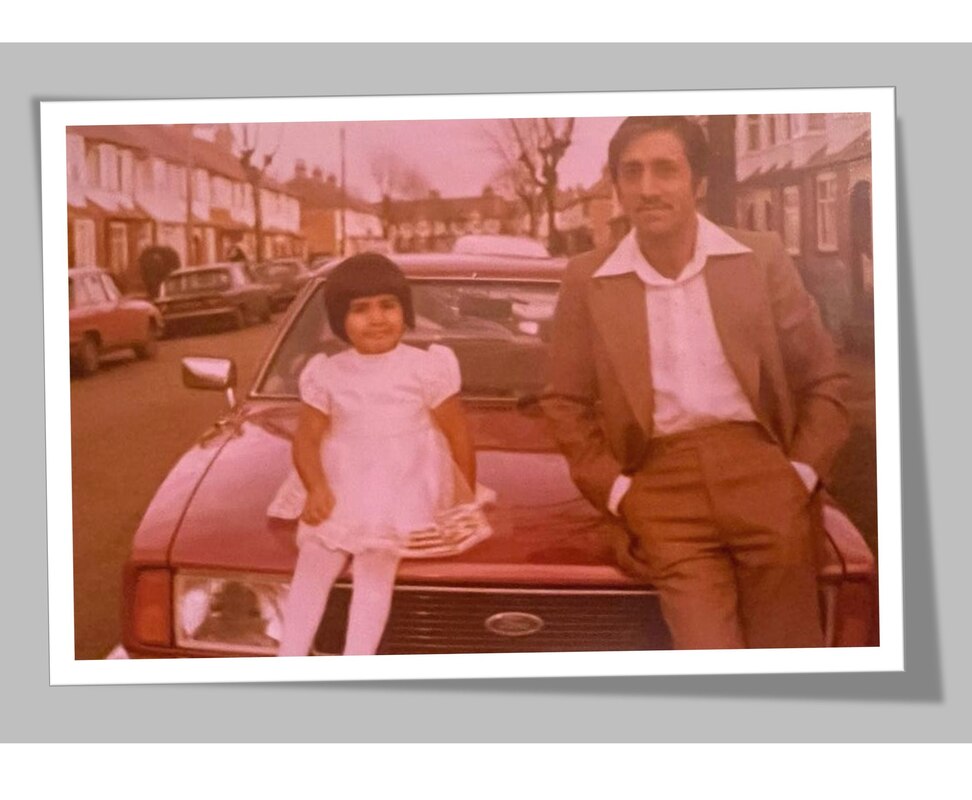
He was careful with money, but he was not tight, and he always encouraged to spend wisely but to spend well. He applied this philosophy to his cars, which he took great joy in. He drove a Peugeot 406 to Tanga for the purpose of his marriage. He said it was no good though, swapped it for a Ford Anglia which turned out to be a dud and then eventually had a stylish VW Beetle. Much later in London, I remember when I was about four years old his relish when he bought a beautiful and very fashionable red Ford Cortina.
Like my grandfather, my father seemed to be able to turn his hand to many skills. He had a sharp intellect, and was also clear in his thinking and an excellent, firm decision-maker. He was well known for his incredible organisational skills and his exceptional memory. I only recently discovered that he had wanted to study medicine or engineering.
I always felt sad that life did not give him the opportunities for a formal education, but it was not for trying. The importance of education was a recurring theme in his life, something he worked hard to gift to his children, and to encourage others to do the same for theirs. While in Dar es Salam, he took a commercial class for bookkeeping. He also wanted to learn German as his intention was to go to Germany to study engineering at university to build on his ‘on the job’ training. He was ‘good at figure work’ (I get my mathematical mind from my Dad) and he passed his Royal Society of Arts 1st stage exam set in London. He was preparing for the 2nd stage. But in his own words for himself: ‘it was not meant to be’.
That was one of the many extraordinary things about my Dad: he did not resent or regret how things unfolded. Because knowledge wasn’t something only to be found in schools. He was the epitome of the self-taught man. He was also always unflinchingly focused on moving forward, planning for the future, being strategic.
It was this strategic planning that means that I’m writing this today from London. Tanganyika won independence from the British in 1961, and united with Zanzibar in 1964 to ultimately become Tanzania. His family held British passports as ‘overseas subjects’. As he was working for an oil company that was about to be nationalised, he recounted that he would have had to choose between a Tanzanian and a British passport.
Which brings me to my father as an embodiment of the British immigrant story.
The hard work that my father and mother put in was part of building Britain post-war, emerging from the difficult 1970s, and nurturing children who now go on to contribute – just as they did – to Britain. It wasn’t just his hard graft, taxes and nurturing of a next generation, he always wanted the communities, the country – and the states around the world – to be good, do good, to do better, especially in treating fairly all its people no matter their social status. He was a citizen who knew his individual responsibilities and worked hard to establish and elevate his family, but a citizen who also took his responsibilities to be part of the social and political process, to be fully informed and to inform others, and to apply the lenses of truth, justice and equality.
Dad was blessed to complete his hajj twice, and made several umrahs including one in 2006. He told me that when he was sitting near the Kaba in Makkah he started talking to the person next to him. That’s exactly the kind of thing Dad always did. Whenever we were travelling he would disappear and start chatting to anyone and everyone and within a few minutes we would suddenly have dinner and guest invitations from all sorts of people.
It turned out that the person next to him was the new Sultan of Sokoto, appointed to this role after his father was killed in an air crash.
Dad – because he never saw anyone as less or more than him, and who was always driven to share knowledge and guidance - was not phased at all. Instead, he gave advice to the new Sultan telling him, now you are a leader in Nigeria, you should read the letter of Ali ibn Abi Talib, the 4th Caliph, sent to the newly appointed governor of Egypt, Malik e Ashtar. This way you can exercise justice. (By the way this letter is an excellent read for successful and just governance, and I do wish our politicians would read it.)
This is what Dad was like, he would talk to anybody and he didn’t care if they were someone in a shop, or the Sultan of a Kingdom. And the thing about Dad was that everyone talked to him. He was humble, approachable, a distinctive, memorable personality.
He always found a connection with others and had a natural power to always fit in and feel comfortable with any and all. He was Indian, African, British, Muslim. Linguistically he was talented. He would encourage my efforts to learn languages at school: French and Spanish, and then later Arabic. But I could not help but admire that by nature he spoke five languages fluently: English, Kutchi, Gujarati, Urdu and Swahili. It hurt my heart though to hear him apologising to people around him that he felt he didn’t speak good English, perhaps worn down by the racism he faced as an immigrant: he was in fact a powerhouse in communicating his message.
‘You have to speak the truth!” was something he would say often. He always encouraged people to speak up, and would tell you to fight for justice. I can’t tell you the number of letters he asked me to help him write to MPs, embassies and people in the public eye because it might create change, but even if it didn’t it was our duty to ensure “they have to know!” Because doing nothing is not an option. And you have to do whatever is within your own capability and sphere of influence.
Like many families of immigrant heritage we had the family lore of how he arrived in Britain with two suitcases and £75. I never really thought much of this till recently, as it’s such a motif of the immigrant story. But the £75 had a specific reason. And the story behind it meant that I might well have had a very different life.
He told me that he looked at the other countries that had recently gained independence and saw that there was great turmoil and he was therefore worried about the stability and security of his new family. He thought Zambia was doing well, and had good opportunities for engineers like him. He was already the supervisor for all the engineers in Tanzania. At that time, only a maximum of £150 could be taken out of the country as part of currency exchange control. He used £75 for his expenses to travel to Zambia to seek employment. He was offered a job, but not accommodation for his family, which was in short supply. And, as someone who always prioritised his family, he felt this made it too risky to relocate to Zambia without surety of where his young family would live. This meant he was left with £75 which he used along with his British passport to travel to London (‘You are making a mistake going to the UK’ said one of his aunts, ‘It’s so cold!’). His family followed soon behind.
I wonder about the many and varied counterfactuals of the life that might have been mine. If my grandfather had not travelled, I might well have grown up in Kutch, India. If he had decided to stay in Aden and marry there – and we had Indian friends and communities that did exactly that – my connection might be to Yemen. If my father hadn’t made the decision to leave Tanzania at all, I might have been born and lived in any number of places in Tanzania, Mingoyo, Lindi, Tanga, Zanzibar, Arusha, Dar es Salam... Perhaps another alternative universe would have seen me living today in Zambia. And yet here I am in London, the daughter of an immigrant adventurer, brave heart, hero.
With his £75 in hand when he landed in London he told me: “I took a taxi and headed to Bayswater. I told the driver to take me to the Porchester Hotel, in Porchester Gardens. The hotel charges were £5 for a week with breakfast, evening meal and bed.” He also told me that he later considered buying one of the five storey Bayswater houses in the 1960s for sale for £6000. (If only Dad, if only!)
The following years were of a growing family establishing themselves in north London (‘We couldn’t believe the toilet was outside the house’ said my parents having come from indoor loos, ‘and you had to go out in the snow!’); or carrying the laundry up the hill to the laundromat; of buying a house (Other homeowners on the street mounted a campaign to prevent this young Asian family from buying it. The bank demanded a 50% deposit because they were of Asian heritage); of intrepid travellers (the house was £6000 in 1972, they did a six week epic journey from Egypt to Iraq via Lebanon, Syria and Saudi Arabia for £1400!); and then much later, me.
Dad was brave, forward thinking, pioneering, independent, resilient and unbelievably hardworking. He had such talent in his hands. He was forever repairing things, painting, decorating, DIYing (he hand-built my rocking crib), fixing the car, and most of all gardening.
He knew how to cook and keep house. When I was a very small child and my Mum was in hospital he ran the household, did the cooking and even brushed and tied plaits in my hair before taking me to school. He was incredibly hands on with all the domestic work, as well as looking after me. In fact, he would not be waiting around for others to do chores. He liked to say “Don’t leave for tomorrow what you can do today, and don’t leave for later what you can do now.”
He was always hungry for news and learning. I can’t remember a single car journey where he was not listening to BBC Radio 4 or the World Service. Before the internet where you can easily access the news, we would go to Brent Cross, and then he would go to WH Smith and read all the newspapers. Honestly, the things he knew about how the system worked, and what to do was extraordinary. He could tell you details about countries, leaders and politics going back decades. “You have to inform yourself” was a key mantra. And he saw it as his responsibility to share that knowledge with others.
In more recent years this extended to him talking about the Qur’an and explaining its verses and then applying it. As one family member recounted after my father’s passing: in any conversation you had with my Dad, he would very quickly turn to a verse of the Qur’an to shed light on the discussion. The Qur’an was not an academic text to be recited by rote. It was a practical guide that applied for both micro and macro events.
If he heard about children in any kind of suffering you could see how much pain it caused him in his heart. And of course, when it came to children, there were none he loved and encouraged more than his beautiful granddaughters, his ‘fragrant flowers’ and his ‘dollies’.
Perhaps most memorably in recent years were his roses. The perfect deep crimson in the perfect rose shape, the softest velvet petals, with the most exquisite fragrance that you could ever imagine, his rose bushes flourished. He would delight in gifting hundreds of individual roses, hand delivered (many by me!) to friends, family and neighbours and their beauty and fragrance went into people’s homes and hearts where even words could not reach. As his nephew described: this was my father’s ‘sadaqah’, an Islamic word for charity or contribution. He gave sadaqah from his talent of growing these roses. He had an appreciation for beauty, and an understanding of the hard work required to nurture it. What I admire and hope to emulate is his instinctive knowledge of the deep inner joy that beauty which touches all the senses brings to the soul.
The roses are perhaps the perfect symbol for Dad: nurtured with care and dedication, absolutely one of a kind, unforgettable, thoughtful about others, and leaving a lasting impression on all those he met.
Nothing was ever too much trouble for him to do for his family. I can hear his voice saying: “If it can make your life easier…” He was absolutely always there.
He managed to strike the incredible balance of trusting absolutely in my judgement, but always being there beside me.
And in recent years I was always right beside him. As those of you who have read my writing about my Mum will know that the last four years (and several years previously) along with my sibling, I was a primary carer to both my parents. For many people one parent takes the lead on caring for the other, but in this case, both were ill. Every day for lunch and dinner I would provide their food, go to their home, ensure they ate; I’d accompany them to hospital appointments for hours even days and nights, answer their messages and calls throughout the day, buy their clothes, take them for drives, organise visitors and a social life – within the constraints of sheltering at home as they were immuno-suppressed. Doing their personal care. Addressing their household admin, managing their never ending paperwork for officialdom, with councils, care agencies, those who were helpful and those who were anything but. All the while as a sandwich generation carer with two small children and a full time job, and all my books and writing.
It is sitting on the knee of my father at the age of four, that I learnt to read the Qur’an. It is with him asking to check my homework, his search for the most excellent of schools, to which he dropped and picked me every day; it was his encouragement that I apply to Oxford – something he was intensely criticised for (because ‘why does a girl need to go to Oxford?’), his commitment to my Islamic education, his uncompromising non-negotiable belief that a woman should be educated and able to stand on her own two feet, that a woman has power and she has the right to exercise it, all of that is what has made me the woman I am today.
Unfortunately, in his last two decades my father faced significant life-changing illnesses. The last 18 months in particular were of immense suffering, especially after Mum –his wife of nearly 60 years – passed away 15 months ago.
The weeks and months after that gave me the chance to tighten my bond with him, and most importantly to care for him one to one to the full extent of my ability. We talked. I collected his stories. We visited my Mum together at the cemetery. We went for drives. I bought gifts on his behalf. If he had a wish, I did my best to make it happen. I gave increasing physical and emotional support, and as much comfort as I could during those challenging days.
The Prophet Muhammad used to refer to his daughter, Lady Fatima, as ‘the mother of her father’ because of the way she looked after him as well as the respect in which he held her. In recent years I was so moved when my Dad used to refer to me as his mum describing how he felt about the way I looked after him.
My most tender moments with him were those where I was able to give him greatest service: I recall gently tying his woollen scarf and putting on his coat and hat before going out. I remember kneeling on the floor to put his socks and shoes on for him. I recall holding his arm while taking him for slow, wobbly walks just a few houses along. In his last days, feeding him food, holding up his cup of tea for him to sip. Reciting Qur’an to him. I miss his text messages and his advice.
The last two months of his life were in hospital and I sat next to him in intensive care for nearly four weeks. As Muslims we believe that illness can be an expiation of sins, and my hope therefore is that he is now joyful in the eternal garden.
One of the most painful experiences I’ve ever had were those weeks of waiting.
The struggle was to manage the overwhelming emotions of not wanting to experience loss, managing the overwhelming anticipatory grief, while also being mindful of the immense responsibility as a person who believes in God to ensure you are there to help your father through the transition of death and support him.
We are not good at facing death.
We are also not good at waiting.
The waiting. With no timeline.
I know that the waiting teaches us to be patient, the waiting teaches us to be in the moment, to submit to what is greater than we are. But it is hard. Harder than almost anything I’ve ever experienced. We don’t talk about it. We should.
The paradox of waiting. Waiting for the thing that you want most because you want his suffering to end. Waiting for the thing that you want least. The thing that is ultimately inevitable.
***
I have lost both my parents within 15 months, and there is little that can reduce how terribly I miss them.
Except for knowing this.
That I was blessed to enjoy my parents till their old age, and a very grown up age of mine. And above all that I had the extreme privilege to be close to them and provide care, support and love for them in my service and duty to them. I am so thankful for this.
They made me the woman I am, and absolutely any drop of goodness from me, any kind word, any orientation to the Divine, any love, kindness, mercy, knowledge or good contribution you experience from me is from them.
In particular, it is my father – my Muslim Asian immigrant father - who has made me the woman I am: to be independent-minded, to be driven, determined, soft-hearted and to work hard to make the world better, while still finding joy in its people and places. And for that I feel immensely blessed and beyond grateful to have had him.
We live in an era where Muslim men are vilified, where immigrants are the ‘other’. We must change that, one story at a time. Which means this is not only my father’s story, but the untold stories of the men who walk with humility among us but have built our societies and made us who we are.
And nowhere was this more evident than how my father as a Muslim man not only believed, but acted to empower Muslim women by advocating for their education, their role in the public space, and their right to speak up and have their rights. It is my privilege to say that I am the daughter of this man.
Which brings me back to the same Ali ibn Abi Talib which my Dad quoted to others, who said: “Live amongst people in such a manner that if you die they weep over you and if you are alive they crave for your company.”
And that certainly seems true for Dad.
Please say a prayer or a Sura Fateha for my Dad and my Mum.
Inna lillahi wa inna ilaihi raajioon. Surely from God we come and to God we return.


Comments are closed.

    Author

    Write something about yourself. No need to be fancy, just an overview.

    Archives

    January 2024
    September 2022

    Categories

    All

    RSS Feed

© COPYRIGHT 2016. ALL RIGHTS RESERVED.
  • Home
  • Books
    • The Story of Now
    • BeYOUtiful: Radiate Confidence, Celebrate Difference & Express Yourself
    • The Extraordinary Life of Serena Williams
    • Generation M: Young Muslims Changing the World
    • Love in a Headscarf: Muslim Woman Seeks the One
  • Media
  • Blog
  • Contact